

Most pendant decisions come down to three choices: the shape of the stone, how big it looks against your neckline, and where the chain sits. Get those right, and the rest- setting, metal, initial or no initial- is a matter of taste.
This guide walks through each decision in the order most people make them, with a quick look at what Luxara's current pendants show for each one.
Quick answer: For everyday wear, many people land on a single round or oval stone of roughly a quarter to a full carat, in a bezel or low-profile setting, on an 18-inch chain. For a gift, an initial or a three-stone pendant adds meaning without guesswork. The sections below explain why, and when to choose differently.
What Makes a Good Everyday Pendant
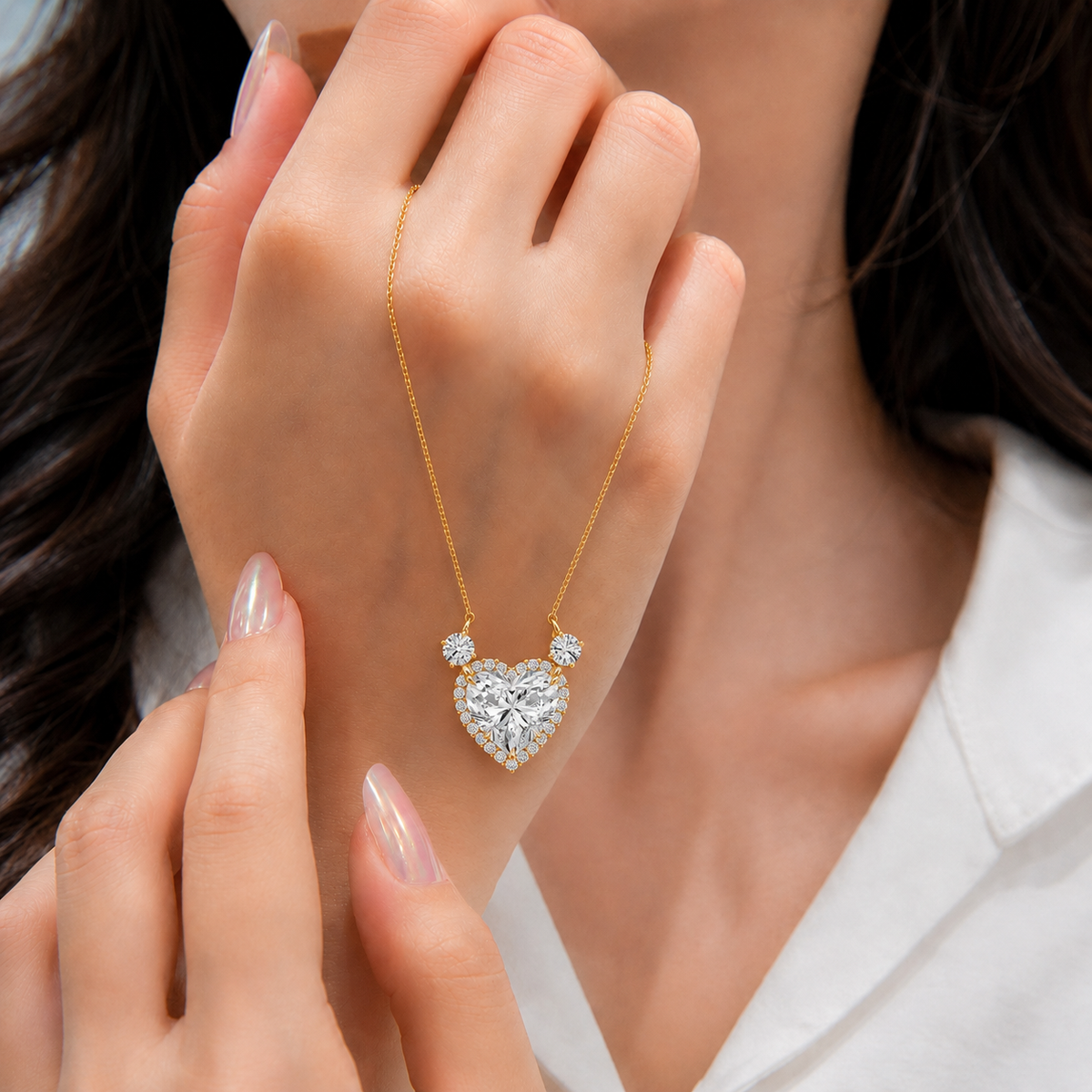
A pendant sits against your collarbone all day, so the practical details matter as much as the stone:
- It sits flat and doesn't snag. Low-profile settings and smooth backs are easier to wear under knitwear and shirt collars.
- It reads well from a normal distance. Across a table, you notice outline and shine rather than the grade on a report.
- It works with what you already wear. Gold tone matters here. If most of your jewelry is yellow gold, a white gold pendant will look like a separate set.
- The chain suits the pendant. A small stone on a long chain disappears; a large pendant on a choker-length chain feels crowded.
One point to settle early: lab-grown diamonds are diamonds. GIA states that a lab-grown diamond has "essentially the same chemical, physical and optical properties as its natural counterpart." The difference is origin, and a reputable seller will tell you which one you are buying. That's also why the gemstone itself is rarely the deciding factor in a pendant; the design is.
Choosing a Diamond Shape for Pendant Jewelry

Shape is the one decision that is purely about taste. If you want the longer version, our diamond shapes guide covers all ten common outlines. For pendants, three families cover most buyers.
1. Round: the safest everyday choice
A round brilliant has no direction, so it hangs evenly no matter how the chain turns. It's the shape most solitaire pendants use, and it suits both a small, quiet pendant and a larger statement one. Luxara's round lab-grown diamond classic pendant necklace for women is a good example of the plain, minimal version.
2. Oval: more length for the same carat weight
An oval stretches the outline vertically, so it tends to look longer on the neckline than a round of similar weight. It also points naturally down toward the neckline, which many people find flattering. The 1-carat oval-cut lab-grown diamond bezel pendant necklace pairs that shape with a bezel, covered below.
3. Pear, heart, marquise and others: a statement, with a trade-off
Pointed shapes such as pear-shaped and marquise-cut diamond pendants draw the eye and suit people who want the pendant to be the focal point. Even a heart-cut diamond pendant looks excellent with formal and modern attire, matching office wear or dinner parties. The trade-off is that corners need protection, so look closely at how the setting guards the tip. These are worth choosing deliberately rather than by default.
Diamond Size: What Carat Weight Looks Like on a Pendant

Carat is weight, not size, but for a round diamond the two track closely. These are typical face-up diameters for round diamonds from the Stuller millimeter-to-carat chart:
| Carat weight | Approx. round diameter |
|---|---|
| 0.25 ct | 4.1 mm |
| 0.33 ct | 4.4 mm |
| 0.50 ct | 5.2 mm |
| 0.75 ct | 5.7 mm |
| 1.00 ct | 6.4 mm |
Two cautions apply to pendants specifically.
Total weight is not stone size. A pendant listed at 0.50 carats total could be one 0.50-carat stone or many smaller ones. Check whether the listing gives total carat weight (often shown as CTW) and how the stones are arranged. For example, Luxara's Round Three Stone Pendant lists approximately 0.495 CTW total across three stones, so each stone is smaller than a single 0.50-carat round would be. That's by design: three stones read as a slightly broader, more intentional shape.
Size on you depends on proportions. Neck length, neckline, and pendant shape all change how large a stone looks. Rather than chase a specific carat number, decide whether you want the pendant noticed (larger face, statement shape) or simply there (a small solitaire that catches light).
Pendant Necklace Chain Length Guide

Chain length decides where the stone lands. These lengths are the common standard.
| Length | Common name | Where it sits |
|---|---|---|
| 16 in | Choker | Close to the throat; suits pendants worn high |
| 18 in | Princess | On the collarbone; the default reference point |
| 20 in | Matinee | Between collarbone and chest; a good base for layering |
| 24 in | Longer standard | Lower on the chest; movement is more visible |
How to choose:
- If you're unsure, start at 18 inches. It's the most versatile for a single pendant.
- Match the neckline. Open necklines like scoop or V-necks suit shorter chains; crew necks suit longer ones. Our advice is simple and worth following: hold a string or an existing necklace against the top you'll actually wear.
- Layering? Keep each necklace at least two inches apart so the pendants don't tangle or hide each other.
Bail and Setting Styles in Pendants

1. Bezel vs. prong
A bezel wraps a thin rim of metal around the stone. It protects the edge, sits low, and has no prongs to catch on fabric, which is why it's a common choice for everyday pendants. A prong setting holds the stone with small metal claws, exposing more of the diamond to light. Four-prong baskets are a widely used choice; three-prong "martini" settings use less metal and look lighter.
Neither is better in the abstract. If you'll wear the pendant daily and under tops, bezel is practical. If you want maximum visible diamond, prongs show more of it.
2. Bail
The bail is the small loop that connects the pendant to the chain. It should be smooth, securely joined, and sized so the chain slides through comfortably without looking oversized. A bail that's too small limits which chains you can use; one that's too large can overpower a small stone. If you plan to swap chains later, check the bail opening.
Lab-Grown Diamond Pendant Styles Compared
| Style | Best for | What to know |
|---|---|---|
| Solitaire | Everyday wear, minimal style | One focal stone; easiest to match with other jewelry |
| Three-stone | Gifts, anniversaries, milestones | Three stones; check total vs. per-stone size |
| Halo | Making a smaller center stone look larger | Surrounded by small stones; more sparkle, a bit more bulk |
| Initial | Personal gifts | Letter-shaped; check how the letter is built and how it hangs |
Luxara Jewels Lab-Grown Diamond Pendants Jewelry
| Pendant | Style | Listed total carat | Certification (as listed) | Price shown* |
|---|---|---|---|---|
| Round Classic Pendant Necklace | Round solitaire-style | approx. 0.500 CTW | IGI Certified | $277 |
| Round Three Stone Pendant Necklace | Three-stone | approx. 0.495 CTW | IGI Certified | $425 |
| Oval Cut Bezel Pendant Necklace | Oval bezel | See product page | IGI Certified | $695 |
| F Initial Pendant Necklace | Initial | approx. 0.252 CTW | IGI Certified | $617 |
Prices shown are for the default 14K yellow gold option; confirm on the product page. These pages list the color as EF and the clarity as VS+.
Metal options on these pages are 14K or 18K in yellow, white, or rose gold.
Initial and Symbolic Pendants
An initial pendant is the easiest personal gift because it removes the "will they like it?" question: the letter does the work. Before buying, check three things: how the letter is built (a continuous outline sits and hangs better than loosely joined parts); whether the letter will hang upright on the chain you choose; and whether it's a single letter for them or a letter that matters to both of you, such as a partner's, child's, or your own third, whether it's a single letter for them or a letter that matters to both of you, such as a partner's, child's, or your own.
Symbolic shapes (hearts, circles, stars, evil eye) work the same way: pick the meaning first, then check the construction. Luxara's diamond pendants collection includes initials, hearts,s and other motifs alongside solitaires.
Gifting a Pendant: A Memorable Moment
Pendants are a low-risk gift because there's no ring size to guess. A few practical points:
- Look at what they already wear. Note their usual metal tone and chain length.
- Keep the design simple if you're unsure. A round or oval solitaire-style pendant is hard to get wrong.
- Choose meaning over size. A smaller initial or three-stone pendant tends to feel more personal than a larger plain stone.
- Check customization options. Luxara offers pendant customization. Check our customized jewelry design page.
Shipping times, return terms, and gift packaging details must be checked on the product page or with the team before ordering for a specific date.
What to Check On Any Pendant Jewelry
Whoever you buy from, a good listing tells you:
- That it's lab-grown, stated plainly.
- Total carat weight and stone count so that you can compare fairly.
- Color and clarity, with the grading lab named. An IGI Laboratory Grown Diamond Report, for example, identifies lab-grown origin and records shape, measurements, and the 4Cs "as mounting permits," since a stone set in jewelry can't always be fully assessed.
- Metal and karat, such as 14K or 18K gold.
- Chain length and type. If it's missing, ask.
- Care guidance. Luxara's product pages recommend warm water and mild soap and storing the piece in a soft pouch.
FAQ
1. What size diamond pendant is best for everyday wear?
For a single round stone, many everyday pendants fall between about 0.25 and 1.00 carat (roughly 4 to 6.4 mm across). Smaller stones sit quietly; larger ones are noticeable. Choose by how visible you want it, not by a number.
2. What chain length should I choose for a diamond pendant?
Start with 18 inches, which rests on the collarbone. Choose 16 inches for a higher, closer fit or 20 inches for a lower, layering-friendly position. Test with a string against your usual neckline.
3. Are lab-grown diamond pendants real diamonds?
Yes. GIA states that lab-grown diamonds have essentially the same chemical, physical, and optical properties as natural diamonds. The difference is origin, which the listing should state clearly.
4. Is a bezel or prong setting better for a pendant?
A bezel is lower-profile and protects the stone's edge, which suits daily wear. Prongs expose more of the diamond. Both are used for everyday pendants.
5. Is an initial pendant a good gift?
Usually, yes: it's personal without needing a size. Most couples and family members gift each other initial diamond pendants on birthdays and holidays like Christmas and New Year's Eve. Check how the letter is constructed and whether it will hang upright on the chain.
6. Can I choose gold color and karat in pendants?
Luxara offers 14K and 18K gold in yellow, white, and rose gold. Yellow gold looks proper throughout the day, white gold offers a premium look like platinum, and rose gold brings a romantic vibe.
7. How much does it cost to buy a 2-carat lab-grown diamond pendant for my girlfriend?
You can spend around $1,500 to $3,000 on a 2-carat pendant, usually available in round brilliant, pear, or emerald cuts in 14K or 18K gold. Make sure to choose a comfortable gold chain length, at least 18 inches.
Conclusion
Pick the shape you'd choose without overthinking it, set a size that matches how visible you want the pendant to be, and choose a chain length by holding something against your usual neckline. Everything else is refinement.
When you're ready to compare, browse Luxara's lab-grown diamond pendants to see solitaire, three-stone bezel, zell, and initial styles side by side.

